
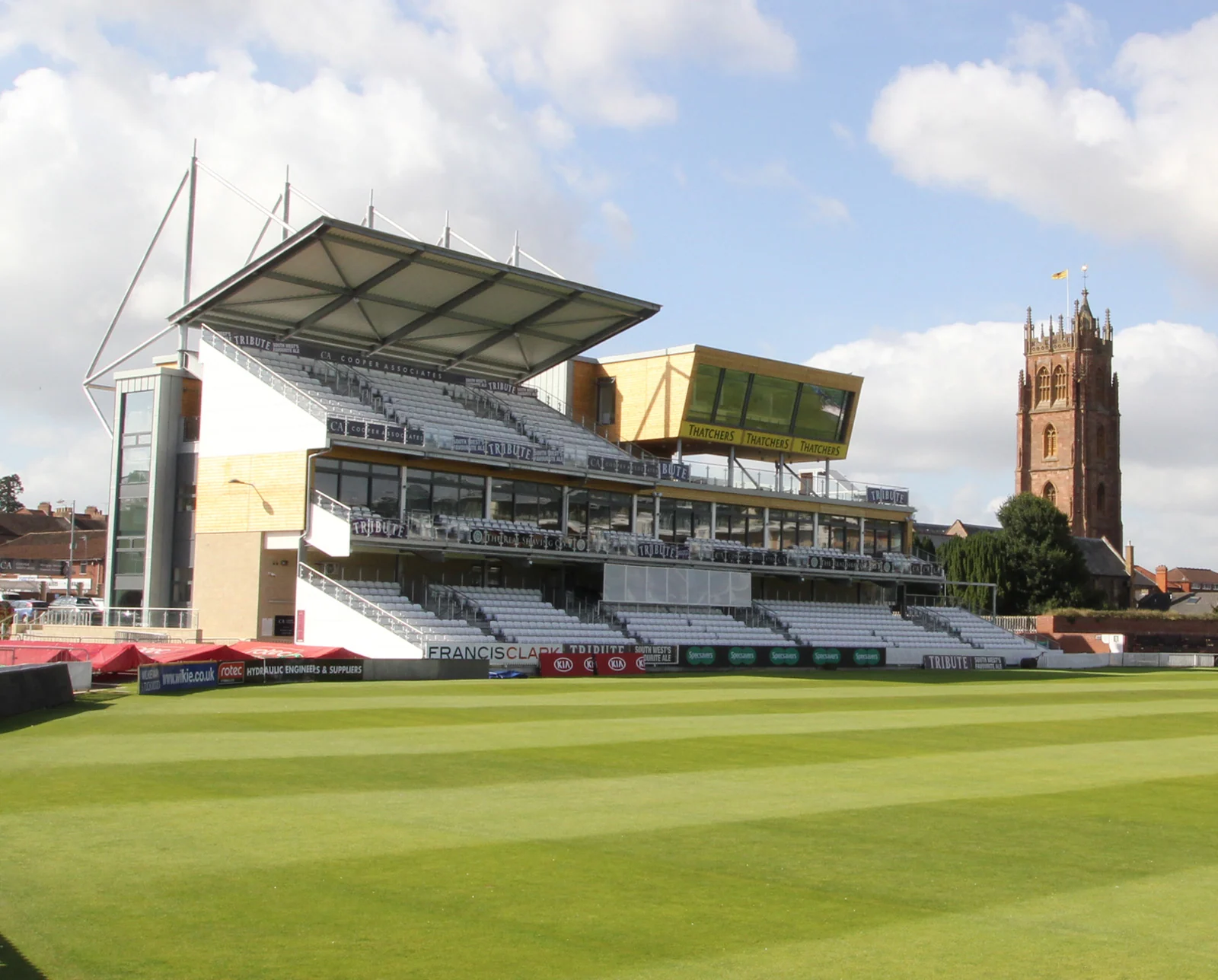
Cricket grounds are unusual places to design for. Unlike many sporting venues, they are not simply containers for a few hours of concentrated action. They are places in which people spend time.
A day at the cricket has its own rhythm. Attention moves between the wicket, conversation, food and drink, friends and family, and the life of the ground itself. There are moments of intense focus, but there are equally moments when you sit back and take in your surroundings. For an architect, that distinction matters.
It was something we thought about a great deal when designing the Marcus Trescothick Stand at Somerset County Cricket Ground in Taunton.
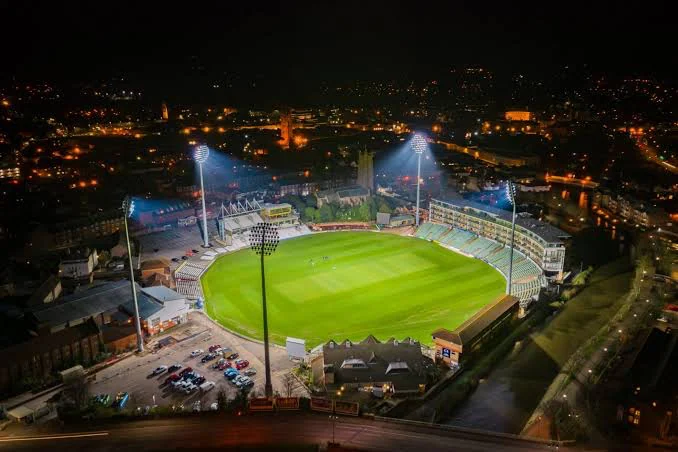
The Cooper Associates County Ground is not an isolated stadium on the edge of a city. It sits within Taunton and forms part of its identity. Like many traditional English cricket grounds, it has developed incrementally over time, with different buildings and stands reflecting different periods in the club's history.
That evolution is part of its character, and any new intervention has to understand that before it starts trying to make its own statement.
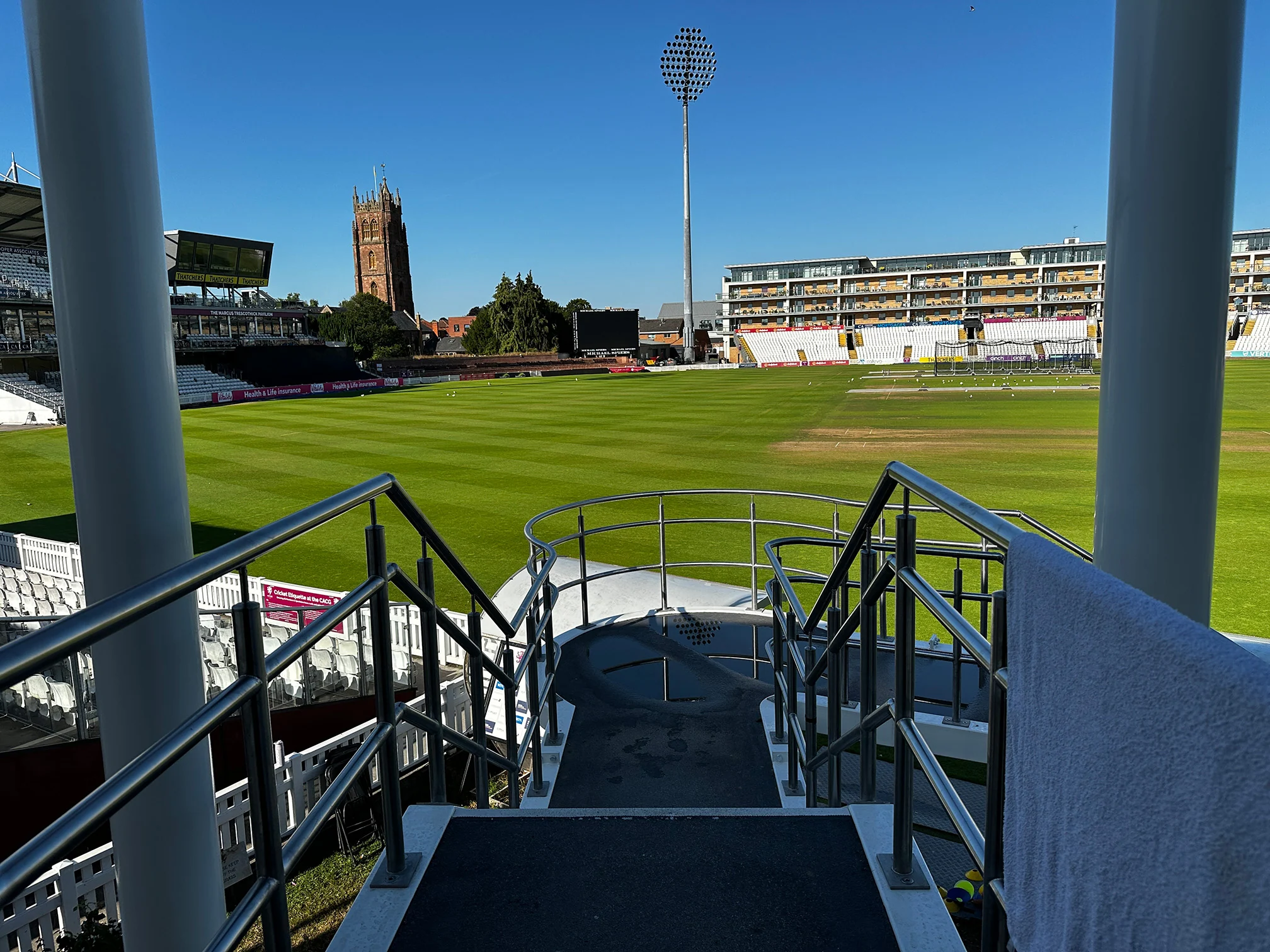
Having the opportunity to return to the ground over many years means you develop an understanding that goes beyond an individual project. You learn how spectators move through it, where views open up, where the ground feels congested and where it needs space. You understand the relationship with the surrounding town, the importance of the church towers on the skyline and, perhaps most importantly, which characteristics should not be designed away.
A cricket ground, not a stadium
There is an important distinction between a cricket ground and the increasingly familiar model of the modern sports stadium.
Football naturally encourages enclosure. The action is continuous, the pitch relatively compact and the spectator's attention is concentrated towards the centre. Cricket is different. Its scale, duration and pauses create a much looser relationship between spectator, building and landscape.
The gaps between stands can therefore be just as important as the stands themselves.
At Taunton, those gaps provide glimpses beyond the boundary and connect the ground back to the town around it. They also contribute to the particular atmosphere of the County Ground: an assemblage of buildings rather than a single architectural object.
When designing within that context, our starting point was not to ask how we could make the new stand dominate the ground. It was to ask how it could become part of it.
Designing from the spectator outwards
A cricket stand can look deceptively straightforward in section: seats facing a pitch with accommodation behind them. In reality, there is a considerable amount going on.
Sightlines are fundamental, of course, but the experience begins long before somebody reaches their seat.
How do spectators arrive? Where do they meet? Can they move around easily? What can they see from the concourse? Where do they go between sessions? How does hospitality operate without becoming disconnected from the atmosphere of the ground?
These questions become particularly important in cricket because spectators occupy a venue for much longer than they would for most other sports.
Comfort is therefore not an added luxury. It is part of the architecture.
The relationship between internal hospitality spaces and external seating is particularly important. People should feel connected to the game whether they are sitting outside, standing with a drink or spending time inside. The building needs to allow those different experiences to overlap rather than treating them as separate activities.
A stand with a particular identity
There was another dimension to the project that made it especially significant, which is perhaps one of the most rewarding aspects of working with county cricket grounds.
These places have extraordinary layers of memory attached to them. Supporters remember particular matches, particular players and often particular seats or viewpoints. Generations of families return to the same ground. One of the structural engineers responsible for the new players walkway even proposed to his wife there.
Architecture enters into that continuing story.
Cricket is changing
At the same time, cricket itself is evolving rapidly.
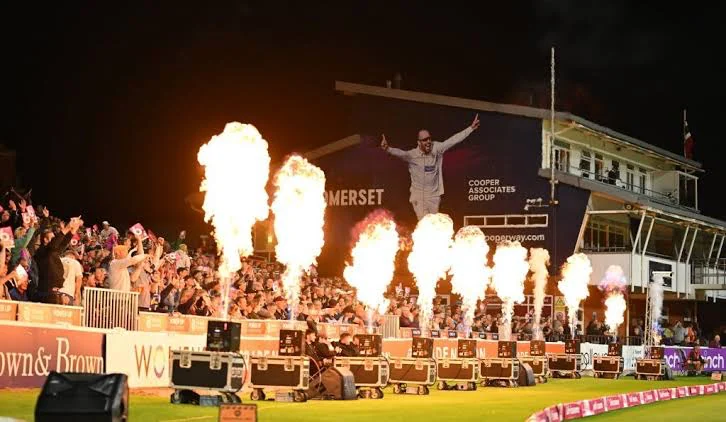
The County Championship, international cricket, T20 and newer short-form competitions place very different demands on grounds. A quiet morning session of a four-day county match and a sold-out evening T20 fixture may take place in exactly the same building but create entirely different environments.
That presents an interesting architectural challenge.
We cannot sensibly design separate grounds for every form of the game, so the buildings have to be adaptable. Hospitality, catering, circulation and spectator areas need to cope with different capacities and different expectations.
Increasingly, cricket grounds also need to work when cricket is not being played.
Conference facilities, hospitality, community uses, events and functions can all help a club make better use of its estate throughout the year. From a sustainability and commercial point of view, that makes considerable sense. A building occupied for far more than a handful of match days is inherently more useful to both the club and the town around it.
The challenge is achieving that flexibility without losing the essential character of the cricket ground.
Building on what is already there
Perhaps this is the wider lesson we have taken from working at Somerset County Cricket Club
Sports architecture can easily become preoccupied with scale and spectacle. Cricket often asks for something subtler.
It asks architects to understand history, views, weather, orientation, movement and the rituals of spectators who may have been coming to the same ground for decades. It asks us to accommodate hospitality and commercial requirements while retaining informality. And it asks new buildings to sit alongside structures from completely different periods and somehow make the whole place feel coherent.
There is something very appealing about that.
As cricket continues to evolve, grounds will inevitably evolve with it. New formats will emerge, expectations will change and clubs will need their buildings to work harder throughout the year.
But I hope the distinctive character of the cricket ground remains.
At Taunton, the architecture is ultimately the backdrop. The important things are the wicket, the club, the players, the supporters and the shared experience of watching cricket.
If a new stand can improve that experience while feeling as though it has found its natural place within the ground, then it has done its job.